
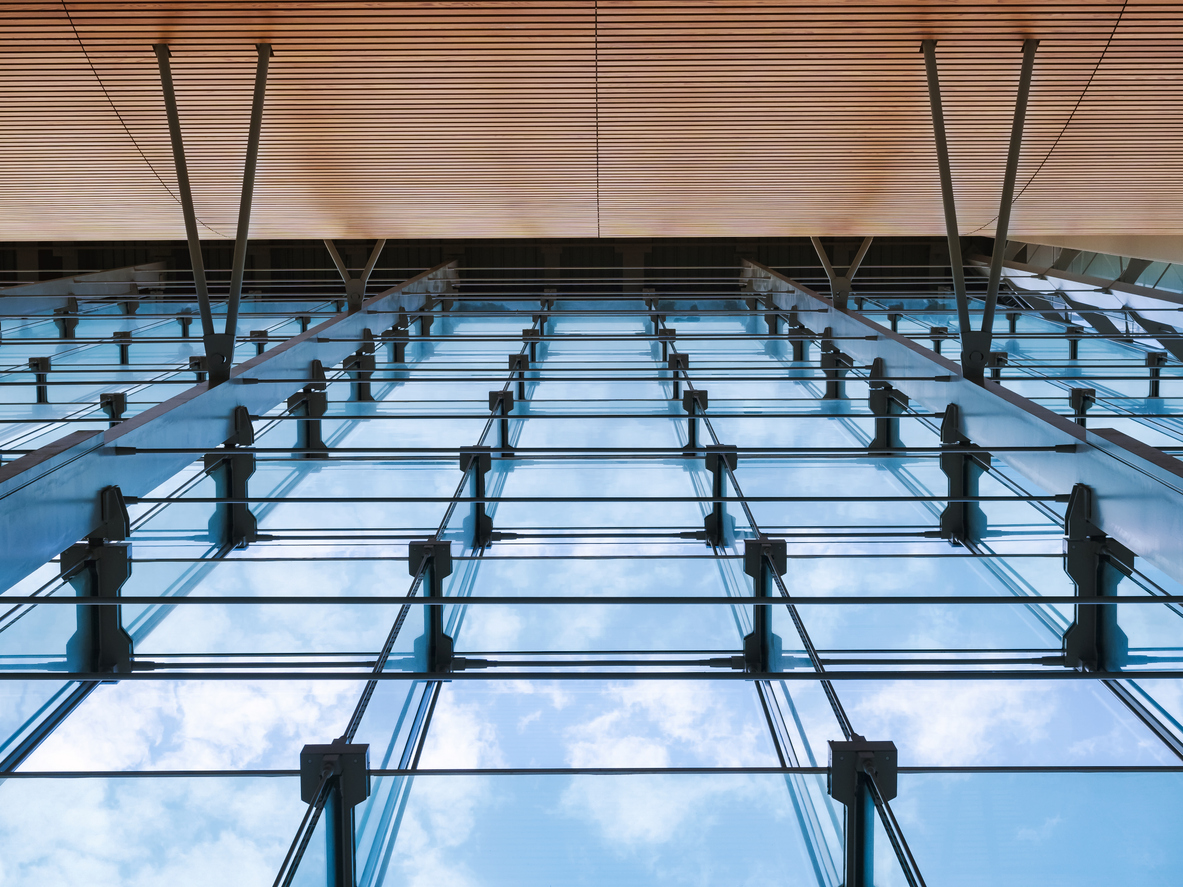
If you spend any time around a building envelope spec, you’ve seen terms like curtain wall, window wall or storefront used almost interchangeably. For architects and GCs making real decisions about a facade, the distinction between these is crucial, especially when it comes to one specific approach: the unitized curtain wall system.
What is a curtain wall system?
A curtain wall is a non-structural exterior wall system, suspended from the building’s structure rather than carrying any of its load. Unlike a window wall or storefront, which spans between floor slabs, a curtain wall runs continuously past them; which is part of why it reads, from the outside, as a single uninterrupted glass plane rather than a stack of individual windows.
What makes a curtain wall “unitized”?
The word refers to how the system is built and installed, not how it looks. In a unitized system, large framed panels – glass, aluminum framing, and seals all pre-assembled – are fabricated and quality-checked in a controlled shop environment, then shipped to the site as complete modules and craned into place, unit by unit and panel by panel.
That’s the key difference from a stick-built system, where the aluminum framing is erected piece by piece on site and the glass is installed afterward, directly on the building. Stick-built has its place, of course. It’s often more cost-effective for smaller or less complex facades, and it offers more on-site flexibility for unusual geometries.
But for mid-to-large commercial projects, unitized systems tend to take gold, for a few reasons:
- Quality control. Fabrication happens in a controlled shop, not on a job site at height and exposed to weather conditions, so tolerances are tighter and testing happens before a unit ever leaves the floor.
- Installation speed. Because each panel arrives complete, install crews are setting finished units rather than assembling a system from scratch in the field – which shortens the time a building sits with an open envelope.
- Consistency at scale. On a high-rise or a large academic or institutional building, repeating a proven, pre-tested unit hundreds of times is far more predictable than field-assembling each one.
Why does this matter for Colorado projects specifically?
Colorado adds its own variables to the equation – high wind loads, seismic considerations, big temperature swings, and the effects of altitude on air and water infiltration testing.
A unitized system’s shop-controlled fabrication makes it easier to engineer and test for those conditions consistently across every unit, before any of them reach 14 stories up a Denver high-rise.
How Horizon Glass approaches this service
Installation in Colorado calls for more than standard curtain wall expertise. Our mountain climate brings its own set of variables, and we build our process around them from the start.
It begins with structural analysis that accounts for Colorado’s high wind loads and seismic considerations, with anchor points engineered precisely to the building structure.
From there, our in-house teams install the aluminum framing system, place the glass panels, and seal everything with weatherproofing materials chosen specifically for our region’s extreme temperature swings.
Every system is custom-engineered with altitude, solar exposure, and local thermal requirements factored in from the design stage – not added on afterward. Before a project is considered complete, it goes through air and water infiltration testing calibrated for high-altitude conditions.
Our factory-trained technicians handle installation to meet strict quality standards and local building codes across the state, and our support doesn’t end at install – we provide ongoing maintenance and service for every curtain wall system we put in, because ensuring the product’s performance is held-up in Colorado’s climate all year-round, not just from day one.
It’s also an area we’re continuing to invest in. As more projects call for faster timelines without sacrificing quality, we’re looking closely at how we can keep pushing what’s possible in our own fabrication process.
Have a project where curtain wall is on the table? Talk to our team about what a unitized approach could look like for your building.